View Trend New Design Home Star-3,View Trend New Home Star-3,View Trend New Home Star-3,Trend New Home Star-3
Gallery
NEXT HOME
NEXT HOME
NEXT HOME
NEXT HOME
NEXT HOME
HOME-STAR3 DESIGN
Showing posts with label arts and crafts. Show all posts

Lace Design Work of Arpad Dekani

Illustration: Arpad Dekani Lace design c1908

Much of the early twentieth century revival of practical lace making, but more particularly that of designing lace within Hungary, can be attributed fairly squarely to Arpad Dekani. Professor Dekani, who started his career relatively humbly as a teacher at a provincial school in Hungary, eventually became a professor at the Arts and Crafts School in Budapest. It was in this position that he had the influence to restructure some of the aims and ambitions of lace production throughout Hungary.

Dekani used old traditional Hungarian patterns as an origin point in which to engender the production of a whole new system of styles for twentieth century lace production. He was also able to engineer the training of students on two levels. Firstly, there were those who would hopefully produce lace as a going concern. These students were trained in all forms of lace making as well as that of book keeping and the general maintenance and organization of a business. On another level Dekani organized the training of students which in turn who become teachers themselves. These newly trained teachers who were well versed in the new production and design parameters that Dekani had set out for the modernisation of Hungarian lace making, would filter out into the traditional areas of lace making in Hungary, particularly in the north of the country. These Dekani disciples if you will, were given the task of restructuring and repositioning local customs and traditional frameworks of lace production, not to industrialise the craft as such, but to give it a decent competitive edge within Europe.

Illustration: Arpad Dekani lace design c1908

A number of areas of traditional lace production in Europe particularly that of Italy and Austria, had already gone through a restructuring process, giving exports a much more contemporary look and feel to their lace design work. Although still based very much as a traditional craft, European lace did see a considerably robust marketing campaign in the late nineteenth century, but particularly that of the early years of the twentieth century, when so many other crafts and traditions were also having to reshape and redesign themselves for the new century.

Hungary as a partner within the Austro-Hungarian Empire, tended to follow the structure already set out by the Austrian craft schools and college system, whereby traditional craft design and decoration was upgraded, restyled, repackaged even. However, Austria was not the only example of this repositioning of design and craft for the new century. Schools and colleges from Glasgow to Moscow were having to re-evaluate the textile craft system, its present position and its potential future in a rapidly expanding market that was becoming increasingly dominated by mass production and consumerism. Hand production of printed and woven textiles, as well as that of embroidery and lace was particularly vulnerable to market forces. The situation was not helped by the increasing reluctance of customers to subsidise these traditional crafts by paying much more for hand crafted work than they would for industrially based work.

Illustration: Arpad Dekani lace design c1908

In some respects the blame for the decline of the craft system of hand production can be placed with the general buying public as much as with industry. Many who could afford to subsidise these old traditions did so on a progressively smaller scale. As fashion began to incorporate the marketing ploy of inbuilt obsolescence, there was even less room for the craft system to manouvere, particularly with a product that was often produced with the intention that it be seen as outside the role of obsolescence and therefore fashion. Even though some craft work might have attempted to compete with fashion, by its very nature and its high price tag, craft products were meant to be bought as long term investments rather than for short term profit.

This by no means implies that Dekani and many others like him across Europe failed in their attempt to redesign and in many cases relaunch craft traditions. There is a long line of repeated craft initiatives that stretch across the twentieth century. Many of these might well have been short term or failed for various marketing, pricing and fashion reasons. However, the craft system is still with us today and as it yet again restructures itself in the form of contemporary craft, we should be thankful for the many individuals, such as Arpad Dekani who kept the ideal of production that was largely outside the increasingly fragile and some might even say destructive cycle of fashion and redundancy.

Illustration: Arpad Dekani lace design c1908


Reference links:
By Hand: The Use of Craft in Contemporary Art
Contemporary Crafts
Form Magazine - Australia
Crafts: Contemporary Design and Technique
Arts and Crafts Furniture: From Classic to Contemporary
Contemporary African Arts and Crafts: On-Site Working with Art Forms and Processes [460 Photographs; 23 Color Plates]
Common Ground: Contemporary Craft, Architecture and the Decorative Arts (Mercury Series)
Craft and Contemporary Theory
Craft and contemporary culture,
In Praise of Hands: Contemporary Crafts of the World
Exploring Contemporary Craft: History, Theory and Critical Writing
Jim Partridge (Contemporary Craft Series) (Contemporary Craft Series)

Anders Zorn Tapestries

Illustration: Anders Zorn. Dalecarlian Scene tapestry panel, 1909

Anders Zorn the Swedish fine art painter is probably better known outside of his native Sweden, as that of an accomplished and highly successful nineteenth and early twentieth century portrait painter. Zorn travelled widely in both Europe and North America and his portraits made him wealthy and acclaimed. However, as if a tonic for the often unrewarding profession of portrait painter, Zorn had a keen interest in the traditions of his native Sweden. The representation of both a rural and traditional basis of life in Sweden became more important to him as his life and career progressed, so that nearer the end of his life the subject of the traditions of Swedish life and culture became much more acute.

Zorn produced a number of compositions with subject matter that were based on the ordinary traditions of rural life in Sweden. These came in a number of disciplines, most admittedly within fine art painting, but some within the traditionally strong Swedish discipline of textiles. This was not particularly unusual for the period as many fine artists were keen to be seen as pan-discipline workers, producing efforts not only in textiles, but also that of ceramics, metal, glass and wood. That much of this work was art rather than design based did often limit the results, but it is still interesting to note the results of the process of a fine art sensibility being transposed into craft or design.

The examples shown here are relatively straightforward transpositions from a fine art origin to that of woven tapestry. Although there is no overly unique interpretation from Zorn, it is interesting to note how he has interpreted his compositions towards a textile based medium. The work has all the appearance of a graphic based dimension, with figures and backgrounds appearing both fresh and spontaneous, giving the impression of an element of contemporary vitality and spontaneity to the traditional rural scenes. Admittedly, this is not always the impression that has been immediately connected to either rural or traditional lifestyles, particularly by those of a more urban disposition.

Illustration: Anders Zorn. Dalecarlian Scene tapestry panel, 1909

All three tapestries are connected and should by rights be seen as a triptych of panels showing various aspects of the one theme. That theme was to illustrate the life lived in the Dalecarlian region of Sweden. Dalecarlia or Dalarna, is an area of the country that had become associated since at least the mid-nineteenth century as being in some respects, the heartland of both Sweden and its culture.  The native Arts & Crafts movement was particularly interested in using Dalecarlia as a metaphor for all that was considered vital in preserving and prolonging the traditions of Swedish life.

Perceived heartlands were a particular necessity for a number of Arts & Crafts movements, more so in Europe than elsewhere. Specific regions and areas were often interpreted as literal vaults containing the uncontaminated traditions and root culture of a nation. Although much of this was clearly romantically misplaced sentiment, it does not change the fact that areas like Dalecarlia became the subject of intense retrospection and rich subject matter for a wide ranging list of creative individuals that included fine artists, designers, craftspeople, photographers, critics, musicians and writers.

These particular pieces by Zorn were even displayed at the 1909 Exhibition of Swedish Applied Art that took place in the capital, Stockholm. Zorn was not the only fine artist represented at the Exhibition, a number of popular and well-placed names in both Swedish fine art and design were represented such as Alfred Wallander, Carl Larsson and Gunnar Wennerberg. Zorn's tapestry work can be seen as a fine example of both the traditions of Swedish craft and culture, along with the sensibilities of a contemporary artist to those traditions.

Illustration: Anders Zorn. Dalecarlian Scene tapestry panel, 1909

Anyone interested in good selection of the fine art work produced by Zorn during his career might wish to follow the link to the Anders Zorn website which can be found below in the Reference links section, along with some relevant books on Zorn that can be found on Amazon.com.

Reference links:
Anders Zorn website
Anders Zorn
Anders Zorn Rediscovered
ANDERS ZORN, His Life and Work
Nationalism and the Nordic Imagination: Swedish Art of the 1890s
Greeting Cards: Anders Zorn Paintings
Anders Zorn In the Woods 19 1/2 x 15 1/2 Print
Anders Zorn 1860-1920: An Introduction to His Life and Achievements
The Prints of Anders Zorn
Anders Zorn 
The Etchings of Anders Zorn: From the Collection of the Springfield Art Museum
Dagmar, 1911 Giclee Poster Print by Anders Leonard Zorn, 24x32

Embroidered Panel by George Washington Jack

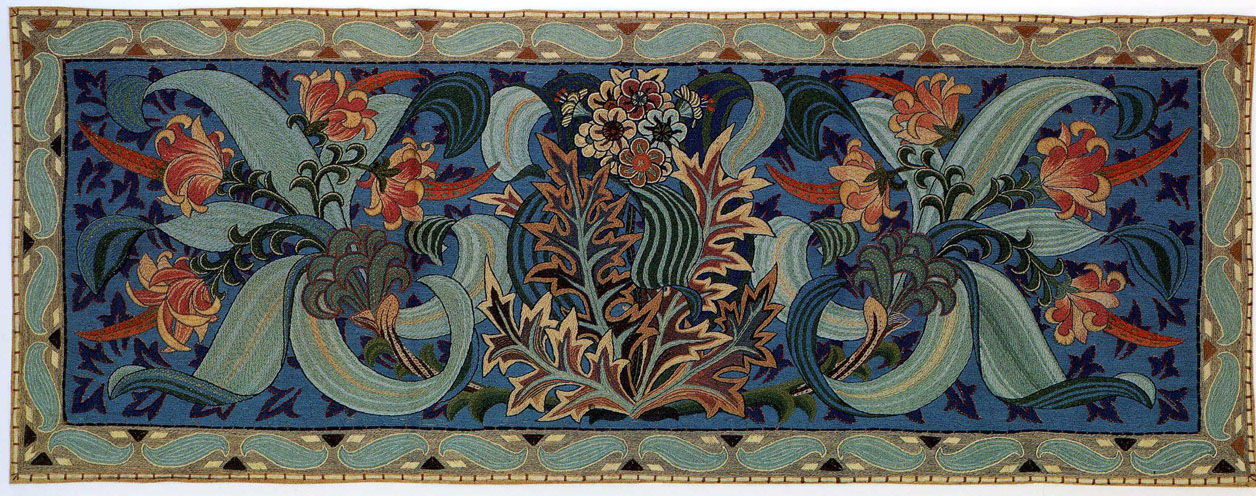
 Illustration: George Washington Jack. Embroidered panel, 1890

George Washington Jack is the patriotically named Scottish American designer who spent much of his professional career in England. Jack trained as an architect and from 1882 became the chief assistant of Philip Webb, taking over sole responsibility for the company in 1900 when Webb retired.

Jack was largely responsible and best remembered for his prodigious amount of furniture design produced for, amongst others Morris & Co. Much of this work was produced during the 1880s when Jack became a convert to the English Arts & Crafts movement. This may well have been through his contact with William Morris, through Morris friendship with Webb and Jack's work for Morris & Co. However, Jack was no mere disciple of Morris, but in fact an independent and enthusiastic supporter of the movement which can be noted by his membership of such prestigious groups and associations as the Art Workers Guild for example.

Although trained as an architect and mostly remembered now for his furniture design work, Jack was also a designer of at least a certain amount of stained glass and textiles. As far as textiles are concerned, a particularly fine example is that of an embroidered panel produced in 1890. The example shown in this article is an excellent representation of what can be achieved through the medium of embroidery. Both the colours and composition are forceful, without appearing strident. There is a rich, though graphic quality to the work that places it very much as an example of the contemporary state of the decorative arts in England as it approached the final decade of the nineteenth century.

It is an example also of Arts & Crafts sensibilities, with the usual use of the abundant elements of the natural world. However, while much of the output of the English Arts & Crafts world was largely tempered by conservative values, along with the characteristic natural inclination towards understatement, Jack's embroidered panel is anything but. A certain element of the exuberant curving of the foliage could be seen as an indication of the inroads being made by the European Art Nouveau movement, and it must be remembered that this piece does date from 1890. However, although elements pertaining to Art Nouveau could be seen in the composition of this piece, it does not necessarily mean that that is what they are.

Art Nouveau struggled to make any headway in England, 1890 being still relatively early for an all out assault by a designer on the English market. This does mean that there was no evidence of the new European movement in England at the time, but is unlikely that a man as steeped in the philosophy of Morris, Webb and the Arts & Crafts movement would have seen the potential of Art Nouveau, when most saw it as a mere fashion fad that had no depth or substance. Most English and in fact British critics saw Art Nouveau as a European, but mostly French folly that would be replaced rapidly by an equally trivial folly. That Art Nouveau made such a fundamental and fairly universal impact on the decorative arts of not only Europe but also that of North America, and was to lead directly into the even more universal and all-pervading Art Deco style, perhaps showed the lack of objective judgement made by the British in regards to that of Europe, but more particularly France.

It would be tempting to imagine that Jack had brought an element of exuberant and youthful vitality from the new world to that of a stuffy and overly traditional old one. It seems unlikely that this is the case as Jack himself was very much an integral part of the English Arts & Crafts movement and of its traditional English philosophy, though it can perhaps not be ruled out entirely.

In the case of Jack's embroidered panel of 1890, it seems more a matter of exuberant detailing on the theme of the English Arts & Crafts mould, but perhaps more specifically of that of Morris. Notably, some of the central foliage seems reminiscent of a Morris design style, particularly some of his more Indian inspired textile work. The embroidered panel also seems similar in some respects to that of a furniture inlay. This perhaps should not be so surprising considering Jacks history of both furniture design and his woodcarving ability. However, whatever the reasoning or origins of the design piece, it is still a fine example of English embroidery work of the late nineteenth century, and should be taken as such.

Reference links:
The Arts and Crafts Movement
Arts and Crafts Movement (World of Art)
The Arts and Crafts Movement in Europe and America: Design for the Modern World 1880-1920
Textiles of the Arts and Crafts Movement
The Arts & Crafts Companion
Arts & Crafts Design

Wallpaper Design by Sidney Haward

Illustration: Sidney Haward wallpaper frieze 1893

Sidney Haward, one of the best known of British textile and wallpaper designers of the period spanning the decades that saw the end of the nineteenth and beginning of the twentieth centuries, is relatively unknown today. Despite the fact that Haward was seen in the same light and at the same design level as other British designers such as Voysey and Mawson, and that he also ran the Haward Design Studio which was to provide Liberty with much of its design work during this period, it seems strange yet interesting how his work seems to have faded away.

The illustrations shown in this article are all wallpaper designs and, apart from the frieze which was produced in 1893, are from the first decade of the twentieth century. Although by no means particularly astounding design-wise, Haward's work is still within the general remit of what can only be called the English Art Nouveau style. In other words an Art Nouveau decorative format that was much more formally based than perhaps was expected to be found as the norm in Europe.

Illustration: Sidney Haward wallpaper design 1908

Haward's pattern work is fairly complex for the period and has some reminiscences and nuances that bind it to the much earlier Gothic styles of Pugin's wallpaper work for example. It is the graphic, but symmetrically standardised format that clearly separates it from anything that might be considered free-flowing and asymmetrical as would be expected with much of the French and Belgian versions of the Art Nouveau.

It is sometimes difficult to separate out the English hesitancy towards the new, their suspicious nature as regards Europe in general, and their natural tendency for the reigning in of any form of decorative excess. These wallpapers, in effect, have tried to find a solution to what many might judge as a difficult assault course of contradictions. As decoration they are by no means subtle and have taken a format so rigidly framed as to appear intransigent and stilted.

Illustration: Sidney Haward wallpaper design 1908

For work that was produced nearer the end of the first decade of the twentieth century, rather than that of the beginning, they appear a little out of synch with the standards of decorative work being produced across Europe, particularly in Germany and Austria. From the days of William Morris and the ascendancy of the English Arts & Crafts movement, English decorative design work seemed to have lost both impetus and direction.

While there was to a certain extent, an interest in England towards the new formats being devised in Europe, the interest tended to be both sporadic and localised. Many were unconvinced that there was any long term gains to be made from the decorative movements in Europe, particularly those that dealt with the future of architecture and design in general. However, it is such a shame that more potential couldn't be identified amongst the English, who were still very much involved with the Arts & Crafts movement, and so therefore much of the groundwork that was laid in Germany for the eventual birth of the Bauhaus, was largely missing in England.

Illustration: Sidney Haward wallpaper design 1907

The Aemilia Ars Society

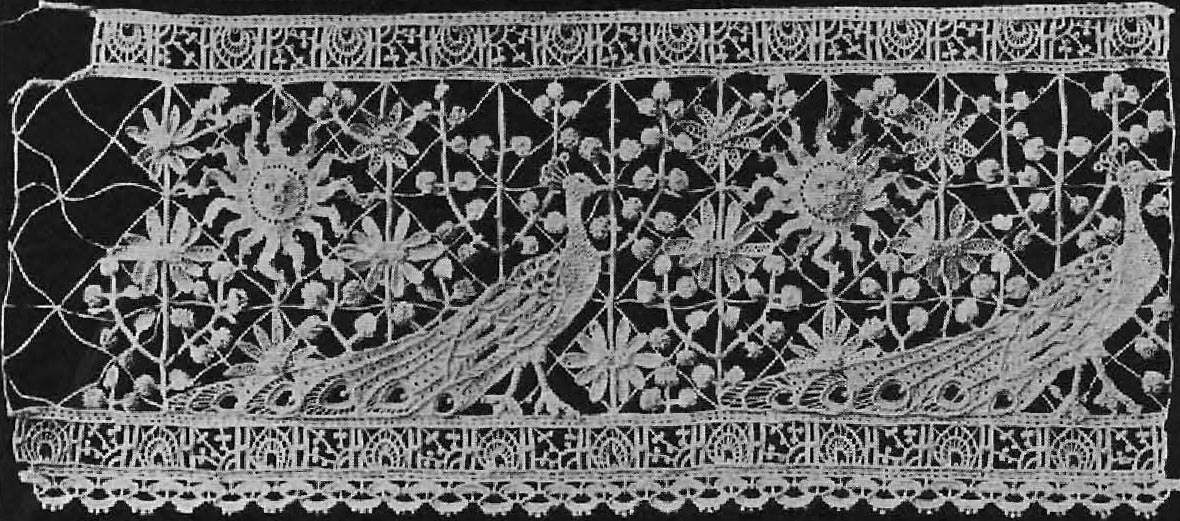
Illustration: Aemilia Ars Society needlepoint lace

Lace making in Europe saw a great, if temporary renewal in its fortunes during the latter half of the nineteenth century. Various organizations and schools were set up across the continent and had varying degrees and rates of success. Many were linked to either government or aristocracy, or both. Much was done to restructure an old but often tired, derivative and unprofitable textile craft.

One of these organizations was the Aemilia Ars Society founded in Bologna in 1898. The society was founded with the help and support of such contemporary Italian creative individuals as Alfonso Rubbiani and Achille Casanova, in order to promote a new and vigorous craft tradition in the Emilia region of Italy. To some extent it drew inspiration from the English Arts & Crafts model, though was entirely Italian in its makeup and cultural inspiration. Although the society itself was by no means limited to the revival of lace production in the region, it was in fact interested in revivals of metal, wood, embroidery and other crafts; it was the work with lace that is best remembered today.

Illustration: Aemilia Ars Society lace design

Although much of the initial lace produced by the Society was based on past greatness, designs were taken from an old volume of lace designs owned by the Marchesi Nerio Malvezzi, this did not mean that new work was not attempted. Although lace work produced by Aemilia Ars was perhaps not as contemporary looking as that being designed further north in schools across the Austro Hungarian Empire, the lace produced in Bologna and eventually all over Italy was seen as being of a particularly high standard with a pedigree based on the history of Italian lace.

Illustration: Aemilia Ars Society drawn linen and lace design

One of the main instigators for the renewed popularity of lace in Italy was the now famous international Milan Exhibition of 1906. At this venue native lace making was given a particularly high profile. A whole room was dedicated to lace work from across Italy. It was exhibited very effectively against a pure white background with more than adequate and sensitive lighting. It was this exhibition space that helped to internationalise the new vibrancy and direction that had been found for one of the older traditions of Italian textile craft.

The problem, as always with such labour intensive crafts, was the lack of enthusiasm provided by any potential lace workers. There was little to inspire women to take up the craft as it had always been and still remained a tiring, time consuming and poorly paid occupation which often led to recurring health problems, particularly those involving eyesight.. There were new and easier options for young women in late nineteenth and early twentieth century Italy, to make far easier money. On top of that was the changing emphasis on fashion which saw a reduction of layers and decoration and a move to produce a more minimal, trimmer and practical figure for women, devoid of lace.

Illustration: Aemilia Ars Society lace coverlet

Although lace making has never truly died as a craft, it often appears as a less attractive textile craft option than perhaps it really is or should be. Although there are no real signs of a large scale revival in the fortunes of lace, it cannot be surmised that there never will be again.

Anyone interested in Italian lace in particular, might like to try the link to the Italian Needlework blog that can be found below in the Reference links section, along with a variety of books on Italian lace that can be easily be found on Amazon.

Illustration: Aemilia Ars Society short curtain in needlepoint lace

Reference links:
Italian Needlework blog
Identification of Lace (Shire Library)
Italian Lace Designs: 243 Classic Examples (Dover Pictorial Archive Series)
Carmela Testa Variety #1- Italian Cutwork & Filet Lace c.1921
Old Italian Lace - Vol. I.
Old Italian Lace - Vol. II.
Italian Laces and Embroideries