View Trend New Design Home Star-3,View Trend New Home Star-3,View Trend New Home Star-3,Trend New Home Star-3
Gallery
NEXT HOME
NEXT HOME
NEXT HOME
NEXT HOME
NEXT HOME
HOME-STAR3 DESIGN
Showing posts with label designer. Show all posts

Owen Jones and Medieval Stained Glass Design

Illustration: Stained Glass from Owen Jones The Grammar of Ornament, 1856

In Britain stained glass design and production saw a massive rise in both popularity and function in the nineteenth century. It was used extensively in both the domestic and ecclesiastical markets and although artistically it can be said that the twentieth century may well have seen the apex of stained glass design work as far as creativity is concerned, it is still the nineteenth century that saw the craft appealing almost universally, probably for the first time since the medieval period.

Although Owen Jones does cover stained glass decorative work in his 1856 The Grammar of Ornament, it is very much tucked away within the larger Medieval Ornament chapter. However, there are twenty nine examples on two large colour plates covering the time period between the twelfth and fourteenth centuries.

As with many examples of ornament around the world and in a number of different time periods that Jones included within his seminal book, he was convinced that on average and with some exceptions, the earlier the period of decoration the more symptomatic it was to an ideal that later became subverted or diluted, ending in an eventual ghost impression of the original ideal. Although this to a certain extent is a simplification of Jones theories regarding the history of decoration, it is also to some extent again, an over simplification on Jones part of the history of the decorative arts. There are always a number of factors that go into the development of styles and eras of decoration. Trying to seek the early purest form of a decorative style and isolating that style from all other influences and cultural cross-pollinations is difficult at the best of times and often impossible.

Illustration: Stained Glass from Owen Jones The Grammar of Ornament, 1856

This theory of early is best, was used by Jones for his all too brief description of medieval stained glass decoration. He closely associated the pattern and ornamental elements of early stained glass design with that of medieval illuminated manuscripts. In some respects this makes a great deal of sense as stained glass, along with painted wall decoration was often the only physical example of the ideals of a religion that was available to the general public. The Bible itself during this period was considered off limits to all but the chosen few and therefore interpretation was limited to the visual.

Jones believed that the more accomplished stained glass designers and craftsmen became, the more pretentious they eventually became, adding superfluous affectations and gimmicks within the work. Eventually this was to lead to the craft trying to imitate the world around it, rather than being content to interpret that world symbolically. As far as Jones was concerned, along with many of his contemporary nineteenth century critics, the attempt was always doomed to failure with the craft tradition and decorative arts always being the ones to suffer most.

Although perhaps Jones critical stand was more of an ideological one than that of one that considered the elements of practical application, there is still much to be said for the theory. There is little doubt that many craft disciplines, particularly those such as stained glass that were heavily defined by their own practicalities, have suffered by the imposition of decorative fashions and styling.  There are particular eras whereby designers either failed to understand the physical limitations of stained glass, or refused point blank to curtail their enthusiasm for decorative schemes in order to accommodate stained glass limits.

This attitude has inevitably led to stained glass work that can only be seen to be classed as such under the very loosest of definitions. It was perhaps no bad thing for Victorian stained glass designers to be gently attracted towards the earlier forms of the craft by such critics as Jones.

Reference links:
The Grammar of Ornament: All 100 Color Plates from the Folio Edition of the Great Victorian Sourcebook of Historic Design (Dover Pictorial Archive Series)
The Grammar of Ornament. Folio Edition
Grammar of Ornament: A Monumental Work of Art
Victorian Stained Glass Pattern Book (Dover Pictorial Archives Series)
Stained Glass and the Victorian Gothic Revival (Studies in Design)
Medieval and Renaissance Stained Glass in the Victoria and Albert Museum
English and French Medieval Stained Glass in the Collection of the Metropolitan Museum of Art, New York (Corpus Vitrearum)

Wallpaper Design by Otto Eckmann

Illustration: Otto Eckmann. Wallpaper design, c1899

Otto Eckmann can be counted as one of the most interesting and diverse designers of his period. When he took up a second career in design at the end of 1894, he put a symbolic end to his first career as a fine art painter by auctioning off his entire collection of work, so as to start anew and fresh as a decorative artist.

Eckmann was involved in the design work of textiles and in particular embroidery and tugs, ceramics, metal, furniture, wallpaper and graphics. It is with wallpaper design that we are concerned with in this particular article. All of the wallpapers featured here were produced by Eckmann in around 1899. They are a stunning display of an individual's approach to wallpaper design and shows that Eckmann was neither overly influenced nor cowed or intimidated by the long history and traditions of the wallpaper industry, particularly by an individual who was approaching commercial design from a fine art background.

Illustration: Otto Eckmann. Wallpaper design, c1899

It could be said that it was actually Eckmann's artistic experience that gave him a particular edge over some of his rivals. It was the individual approach to both styling and composition that made his work appealing for both its novelty and its decorative potential. It was this external attitude that often produced work by artists and designers that stood out when they approached another and relatively unfamiliar discipline, achieving results of unexpected and unusual directions. However, this was not always the case and there were some spectacularly dire results of cross-discipline experiments. These failed ventures have proved to be of a serial nature and have dogged the decorative arts world down to our own contemporary era, mostly in the form of celebrity design launches.

Illustration: Otto Eckmann. Wallpaper design, c1899

Eckmann himself was not of this ilk and the wallpaper design work that he produced from the 1890s until his death in 1902 at the incredibly early age of thirty seven, show a clear definition of his approach to the decorative arts. It has been said by many that the artist turned designer was heavily influenced by the Japanese artistic and decorative format, and while this is true to a certain extent, it can only ever be classed as one thread of the creative work of Eckmann, not the only one.

It is the graphic work produced during the last years of his life that tended to influence the rest of his work through the various disciplines. This is an interesting development as many of the decorative arts had come to rely on the defined graphic quality of flat design. This came to be particularly true at the end of the nineteenth century when considering the textile and wallpaper disciplines for example. A number of illustrators and graphic artists became involved in wallpaper design at the turn of the century and there was a relatively busy and productive cross-pollination of ideas and theories that was to include the whole world of poster art, text, book illustration and wallpaper design.

Illustration: Otto Eckmann. Margueriten wallpaper design, c1899

It was this fruitful period that coincided with the general European Art Nouveau movement, known more specifically in Germany as the Jugendstil of which Eckmann became one of the leading lights. It was with the help of the individual styling of Eckmann's work along with that of others in Germany, that the Jugendstil made its own unique contribution to that of Art Nouveau, often countering to a certain extent, the inbuilt and often overly conscious flamboyance of the French and Belgian versions of the movement.

As with so many scenarios of the early death of a talented individual, it would have been interesting to have known how Eckmann had he lived past 1902, would have affected and influenced not only the dynamics of German decorative arts under the Jugendstil, but much further a field towards that of German Modernism. How his own personal career would have faired during the first and most important half of the twentieth century, we will never know.

Illustration: Otto Eckmann. Self Portrait


Reference links:
Modern Style: Jugendstil/Art Nouveau 1899-1905
Jugendstil, Graphik und Druckkunst
Art nouveau in Munich: Masters of Jugendstil from the Stadtmuseum, Munich, and other public and private collections
Jugendstil Art Nouveau
Ornament und Illustration um 1900: Handbuch fur Bild- und Textdokumente bekannter und unbekannter Kunstler aus der Zeit des Jugendstil (Asthetik der Alltagswelt) (German Edition)

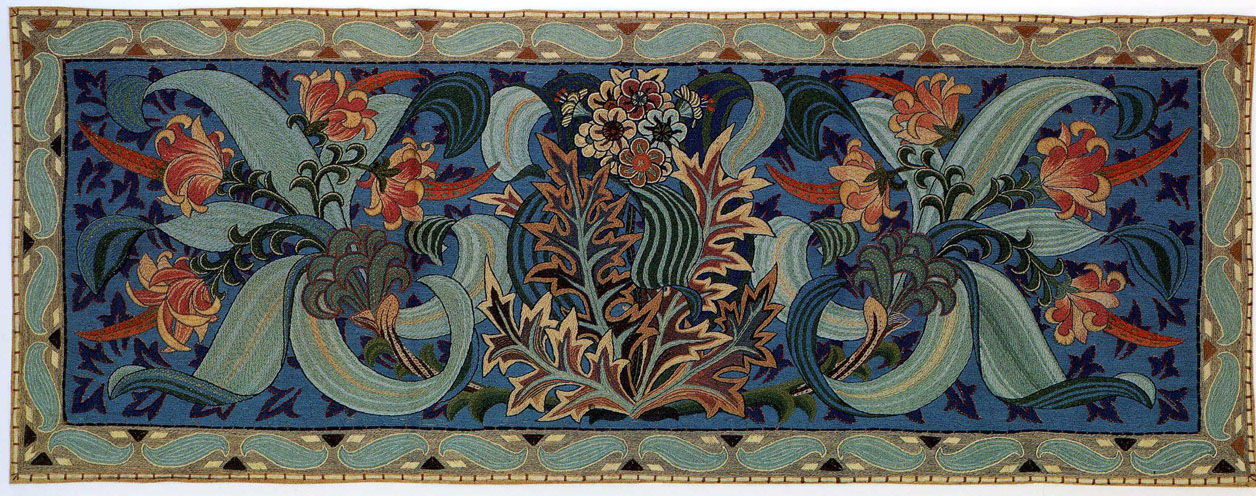
Embroidered Panel by George Washington Jack

 Illustration: George Washington Jack. Embroidered panel, 1890

George Washington Jack is the patriotically named Scottish American designer who spent much of his professional career in England. Jack trained as an architect and from 1882 became the chief assistant of Philip Webb, taking over sole responsibility for the company in 1900 when Webb retired.

Jack was largely responsible and best remembered for his prodigious amount of furniture design produced for, amongst others Morris & Co. Much of this work was produced during the 1880s when Jack became a convert to the English Arts & Crafts movement. This may well have been through his contact with William Morris, through Morris friendship with Webb and Jack's work for Morris & Co. However, Jack was no mere disciple of Morris, but in fact an independent and enthusiastic supporter of the movement which can be noted by his membership of such prestigious groups and associations as the Art Workers Guild for example.

Although trained as an architect and mostly remembered now for his furniture design work, Jack was also a designer of at least a certain amount of stained glass and textiles. As far as textiles are concerned, a particularly fine example is that of an embroidered panel produced in 1890. The example shown in this article is an excellent representation of what can be achieved through the medium of embroidery. Both the colours and composition are forceful, without appearing strident. There is a rich, though graphic quality to the work that places it very much as an example of the contemporary state of the decorative arts in England as it approached the final decade of the nineteenth century.

It is an example also of Arts & Crafts sensibilities, with the usual use of the abundant elements of the natural world. However, while much of the output of the English Arts & Crafts world was largely tempered by conservative values, along with the characteristic natural inclination towards understatement, Jack's embroidered panel is anything but. A certain element of the exuberant curving of the foliage could be seen as an indication of the inroads being made by the European Art Nouveau movement, and it must be remembered that this piece does date from 1890. However, although elements pertaining to Art Nouveau could be seen in the composition of this piece, it does not necessarily mean that that is what they are.

Art Nouveau struggled to make any headway in England, 1890 being still relatively early for an all out assault by a designer on the English market. This does mean that there was no evidence of the new European movement in England at the time, but is unlikely that a man as steeped in the philosophy of Morris, Webb and the Arts & Crafts movement would have seen the potential of Art Nouveau, when most saw it as a mere fashion fad that had no depth or substance. Most English and in fact British critics saw Art Nouveau as a European, but mostly French folly that would be replaced rapidly by an equally trivial folly. That Art Nouveau made such a fundamental and fairly universal impact on the decorative arts of not only Europe but also that of North America, and was to lead directly into the even more universal and all-pervading Art Deco style, perhaps showed the lack of objective judgement made by the British in regards to that of Europe, but more particularly France.

It would be tempting to imagine that Jack had brought an element of exuberant and youthful vitality from the new world to that of a stuffy and overly traditional old one. It seems unlikely that this is the case as Jack himself was very much an integral part of the English Arts & Crafts movement and of its traditional English philosophy, though it can perhaps not be ruled out entirely.

In the case of Jack's embroidered panel of 1890, it seems more a matter of exuberant detailing on the theme of the English Arts & Crafts mould, but perhaps more specifically of that of Morris. Notably, some of the central foliage seems reminiscent of a Morris design style, particularly some of his more Indian inspired textile work. The embroidered panel also seems similar in some respects to that of a furniture inlay. This perhaps should not be so surprising considering Jacks history of both furniture design and his woodcarving ability. However, whatever the reasoning or origins of the design piece, it is still a fine example of English embroidery work of the late nineteenth century, and should be taken as such.

Reference links:
The Arts and Crafts Movement
Arts and Crafts Movement (World of Art)
The Arts and Crafts Movement in Europe and America: Design for the Modern World 1880-1920
Textiles of the Arts and Crafts Movement
The Arts & Crafts Companion
Arts & Crafts Design

Wallpaper Motifs of A W N Pugin

Illustration: A W N Pugin Wallpaper design 1840s

The decorative work of Augustus Welby Northmore Pugin is often seen to be a style that was both complex and highly ornamented. While this is true of a certain percentage of his decorative work, particularly that as seen in the Palace of Westminster where overlayering and gilding seemed to rule the day, it would be unfair to say that this was the only contribution made by Pugin to the decorative arts.

The wallpaper design works shown in this article were all produced by Pugin during the 1840s. While these examples were by no means the only wallpaper work produced by Pugin during this period, they do give an indication of perhaps a less formal, or at least less ceremonial, aspect to his style.

Illustration: A W N Pugin Wallpaper design 1840s

These charming and very English motif wallpapers are examples of what was to be known as the Victorian Gothic Revival. Although the Revival itself could appear excessive in certain circumstances, thinking of the Palace of Westminster again, much of the decorative pattern work could often appear in a relatively simplified form. This draws analogies at least with the start of the Reform Movement of the 1850s and onwards, but also that of, if not the styling at least the sentiment and philosophy, William Morris and the later Arts & Crafts movement.

Pugin himself, like all of us, was inconsistent and contradictory. On one level he talked of an early version of what we would see as Form follows Function with the quote: there shall be no features of a building which are not necessary for convenience, construction and propriety. Although this quote does apply specifically to architectural structure and not surface decoration, it does call into question some of his judgements concerning internal decorative schemes, thinking yet again of the Palace of Westminster, which of course stands out before all others in it's over embellishment. However, with caution, we can say that these particular wallpaper designs produced in the 1840s were unusual for British interior decoration.

Illustration: A W N Pugin Wallpaper design 1840s

Many wallpapers of this era tended to overstate their presence with cascades of full blousy flowers, ribbons and other paraphernalia that made walls appear festooned with jungles of impenetrable foliage that bordered on thickets. It was this type of decorative pattern work that the reform movement tried to temper, if not discard altogether. With an individual such as Pugin, the movement had an instant, if inconsistent champion of the merits of a structural vocabulary in the discipline of pattern design and surface decoration in general.

Even Pugin's more complex and heraldic type wallpapers have an underlying and simplified structure and framework to them. This was often missing from many of the more floral representations that were so popular with public, manufacturers and retailers alike. It was this underlying structural simplicity that was such a part of so much of Pugin's output, which makes him stand out as one of the early pioneers of Victorian decorative art and pattern work.

That Pugin died at the ridiculously early age of forty was a particularly tragic loss to the decorative arts of Britain, but also potentially that of both the Reform and the Arts & Crafts movement. By his removal from the design world in 1852, Pugin was unable to contribute towards the changing Victorian world of the 1850s and 1860s which saw the introduction of new art and design schools and colleges, the Reform Movement under Henry Cole and the rise of both William Morris and the Arts & Crafts phenomenon.

Illustration: A W N Pugin Wallpaper design 1840s

Pugin might well have not become a particularly strident supporter of any of the movements and forms that the decorative arts took in Britain during the mid-nineteenth century. He might well have voiced a counter-argument against reform, that would have been his prerogative of course, and probably within his nature to be deliberately both antagonistic and contrary in equal measures. However, if the imagery of the motifs of these simplified and clutter free wallpapers were to continue, Pugin may well have found himself alongside Henry Cole and Owen Jones amongst others, perhaps even championing the causes and ideals that called for some form of tempering and plain speaking within the decorative arts world.

Although there is a decidedly thin line between some of the aspects of Pugin's work, the Reform movement, William Morris and the Arts & Crafts movement, the line is there and Pugin was an inspiration, at least partially,  to a number of designers in the decades following his death in 1852. It is these designers who were to take elements of Pugin, along with other examples and influences, and were able to transform British decoration and pattern work into a truly unique phenomenon that was to influence and mould much of the rest of the Victorian era in both Britain and indeed much further afield.

Reference links:
A. W. N. Pugin: Master of Gothic Revival
A.W.N. Pugin: An Annotated Critical Bibliography
Contrasts and True Principles
The Present State of Ecclesiastical Architecture
An Oak Kneehole Desk by A.W.N Pugin (1812-1852) Giclee Poster Print by Alvar Aalto, 9x12
The Stained Glass of A.W.N. Pugin
The Collected Letters of A. W. N. Pugin: Volume I: 1830-1842 (Collected Letters of A.W.N. Pugin)
The Collected Letters of A. W. N. Pugin: Volume 2: 1843-1845 (Collected Letters of A.W.N. Pugin)
The Collected Letters of A. W. N. Pugin: Volume 3: 1846-1848 (C Clpug T Collected Letters of)
Pugin-land: A.W.N.Pugin, Lord Shrewsbury and the Gothic Revival in Staffordshire

Gunnar Wennerberg Tapestry design

Illustration: Gunnar Wennerberg The Willows tapestry design c1913

The Swedish designer Gunnar Wennerberg is probably better known inside and outside his native Sweden, for the innovative glass and ceramic decorative work that he produced during the last few years of the nineteenth century and the start of the twentieth century. However, Wennerberg also produced a certain amount of textile work, particularly but not exclusively for the Handarbetets Vanner and the Licium.

Wennerberg produced a number of tapestries during the first decade of the twentieth century and those shown in this article give some indication at least as to the style and compositional qualities that were very much associated with him at the time.

Wennerberg is often seen and categorised as an Art Nouveau designer, particularly as regards his use of foliage and flora for decorative means. However, his style bore little resemblance to the excesses of French and Belgian Art Nouveau and some would see it as somewhat typical of the Swedish love for nature based themes. This is born out distinctively with The Willow tapestry, which although having certain aspects in common with Art Nouveau, tends towards a much sparser and tranquil examination of nature than would be expected within the general Art Nouveau movement. This was one of Wennerberg's particular traits and it can be seen within the other compositions also shown here.

Illustration: Gunnar Wennerberg tapestry design c1905

It is interesting to note that it could be said that Wennerberg's extensive work within the glass and ceramics industries, was somewhat reflected within his later textile work. The imagery and compositional balance are interestingly similar in style with what would be expected both within stained glass work and also that of ceramics. The use of light, particularly within The Willows, is almost similar to a ceramic glaze, and perhaps this was not purely coincidental but could be seen as that of a conscious or unconscious bleeding through of ideas and strategies from another medium altogether.

The greatest boon to cross discipline designers and artists is when the tools and vocabulary of one discipline are used either for the same purpose or for that of a completely different aspect within another discipline. It is this cross-fertilization that has given us many purposeful creative constructs and indeed a number of happy accidents as well.

Wennerberg, although not strictly a textile designer or artist, should be included within the framework of Sweden's prestigious textile crafts, particularly that of tapestry design of which Wennerberg produced some excellent examples that were neither derivatave of the rest of contemporary Europe, or indeed that of Swedish traditional crafts. His work is an excellent example of the individuality that can be achieved by both artist and designer when considering the importance of the uniqueness of an individual's creative journey, rather than that of fashion, fad and styling.

Illustration: Gunnar Wennerberg tapestry design c1909

Incidentally Gunnar Wennerberg should not be confused with the other Gunnar Wennerberg, who was the Swedish poet and composer who died in 1901, Wennerberg the designer died in 1914.


Reference links:
Scandinavian Design (Taschen 25)
RORSTRAND: SWEDISH ART NOUVEAU PORCELAIN, FROM THE ROBERT SCHREIBER COLLECTION
Rorstrand Porcelain: Art Nouveau Masterpieces
Vavda tapeter (Swedish Edition)
SWEDISH TEXTILE ART: Traditional Marriage Weavings from Scania (The Nasser D. Khalili Collection of Swedish Textile Art)

Wallpaper Design by Sidney Haward

Illustration: Sidney Haward wallpaper frieze 1893

Sidney Haward, one of the best known of British textile and wallpaper designers of the period spanning the decades that saw the end of the nineteenth and beginning of the twentieth centuries, is relatively unknown today. Despite the fact that Haward was seen in the same light and at the same design level as other British designers such as Voysey and Mawson, and that he also ran the Haward Design Studio which was to provide Liberty with much of its design work during this period, it seems strange yet interesting how his work seems to have faded away.

The illustrations shown in this article are all wallpaper designs and, apart from the frieze which was produced in 1893, are from the first decade of the twentieth century. Although by no means particularly astounding design-wise, Haward's work is still within the general remit of what can only be called the English Art Nouveau style. In other words an Art Nouveau decorative format that was much more formally based than perhaps was expected to be found as the norm in Europe.

Illustration: Sidney Haward wallpaper design 1908

Haward's pattern work is fairly complex for the period and has some reminiscences and nuances that bind it to the much earlier Gothic styles of Pugin's wallpaper work for example. It is the graphic, but symmetrically standardised format that clearly separates it from anything that might be considered free-flowing and asymmetrical as would be expected with much of the French and Belgian versions of the Art Nouveau.

It is sometimes difficult to separate out the English hesitancy towards the new, their suspicious nature as regards Europe in general, and their natural tendency for the reigning in of any form of decorative excess. These wallpapers, in effect, have tried to find a solution to what many might judge as a difficult assault course of contradictions. As decoration they are by no means subtle and have taken a format so rigidly framed as to appear intransigent and stilted.

Illustration: Sidney Haward wallpaper design 1908

For work that was produced nearer the end of the first decade of the twentieth century, rather than that of the beginning, they appear a little out of synch with the standards of decorative work being produced across Europe, particularly in Germany and Austria. From the days of William Morris and the ascendancy of the English Arts & Crafts movement, English decorative design work seemed to have lost both impetus and direction.

While there was to a certain extent, an interest in England towards the new formats being devised in Europe, the interest tended to be both sporadic and localised. Many were unconvinced that there was any long term gains to be made from the decorative movements in Europe, particularly those that dealt with the future of architecture and design in general. However, it is such a shame that more potential couldn't be identified amongst the English, who were still very much involved with the Arts & Crafts movement, and so therefore much of the groundwork that was laid in Germany for the eventual birth of the Bauhaus, was largely missing in England.

Illustration: Sidney Haward wallpaper design 1907