View Trend New Design Home Star-3,View Trend New Home Star-3,View Trend New Home Star-3,Trend New Home Star-3
Gallery
NEXT HOME
NEXT HOME
NEXT HOME
NEXT HOME
NEXT HOME
HOME-STAR3 DESIGN
Showing posts with label embroidery. Show all posts

Bohemian Embroidery

Illustration: Egerland embroidered cuff

Bohemia is the westernmost region of the modern Czech Republic and for centuries was part of the multi-ethnic and sprawling Austro-Hungarian Empire. Bohemia itself was, to a certain extent, an example of at least a bi-ethnic community with both Czech and German towns and communities within its regional borders.  The embroidery within this article is generally Bohemian in context, but to be more specific it concerns what was generally known as Egerland embroidery. Egerland, surrounding the town of Eger, modern day Cheb, was in the extreme western area of Bohemia and was until as recently as the end of the Second World War, largely populated by those of German descent.

Illustration: Egerland embroidered cuff

In this respect it is probably wise to differentiate, at least partially, between German and Slav embroidery in the region. All the examples of embroidery shown here are of Ederland and therefore German origin. The rest of Bohemia tended to follow the larger Slavic tradition of national costume with large areas of embroidery work. However, Ederland embroidery was much more localised, and became more so the closer we get to the twentieth century where modern clothing replaced much of the traditional national costumes of the area. Embroidery became limited to much smaller areas of decoration, particularly around the cuffs of shirts and blouses.

Traditional Egerland colours for embroidery work tended to contain large amounts of blue and yellow, rather than the predominant red of Slavic embroidery. Whether the colour variation was used to differentiate regions and ethnic divisions is unclear, although the Egerland population's natural and consistent sympathy towards German culture, whether that be Austria itself or neighbouring Bavaria, rather than with the Slavic Czechs in the rest of Bohemia, may have something to do with the consistency of colour.

Illustration: Egerland embroidered cuff

What is interesting about the design work shown here is how closely at least some of the examples are to the decorative work produced at the turn of the twentieth century, particularly by those designers associated with the Wiener Werkstatte. This groundbreaking and popular decorative movement, which was founded in 1903 and was to dominate the decorative arts of Vienna for at least a decade or more, was dominated in its turn by what at the time was considered traditional peasant art. The regional diversity of the Austro-Hungarian Empire proved a particularly rich resource for the designers of the Werkstatte.

Bohemia was connected directly to the Wiener Werkstatte on a number of levels. At least a dozen of the large contingent, who worked for the Werkstatte over its lifetime, were born within Bohemia or Moravia, including Josef Hoffmann himself. Factories and workshops within the region also supplied products with the distinctive Wiener Werkstatte look, particularly in glass of which Bohemia was and still is famous.

Illustration: Egerland embroidered cuff

Although no sweeping statements can be made about designers with Bohemian or Moravian backgrounds swamping the Werkstatte with ethnically derived decoration, it is within the realms of possibility to say that at least some of the background and initial ideas of an artist or designer can originate from childhood memories and neighbourhoods. Josef Hoffmann himself has gone on record as admitting that his Moravian background influenced at least some of his Werkstatte decorative work.

Whatever the reasoning behind any influence on the Werkstatte itself, the design work shown here is fresh, lively and unpretentious. There is little of any classically static engineering of the decoration, with work appearing to be both bold and spontaneous. This general style of embroidery work which could be found across Central and Eastern Europe provided an enormous inspirational vocabulary for a number of schools, organizations and movements of the late nineteenth and early twentieth centuries. It is certain that its influence, at least to some extent has been downplayed by the perceived influences of more exotic areas of the world outside of Europe. Perhaps this has more to do with European ethnic and regional decoration being judged as largley unaesthetic and broadly amateur in quality and nature. However, this makes it all the more important to recognise as an influence on the decorative arts of Europe.

Illustration: Egerland embroidered cuff

Egerland Embroidery, like all other regions of European embroidery work, has a decorative list of parameters that makes it unique within the larger European framework. It is this regional uniqueness, all with separate vocabularies, that has allowed European embroidery to become such a rich, diverse and influential medium that has spread well beyond its own craft.

Reference links:
Peasant Art in Austria and Hungary
Wiener Werkstatte: 1903-1932 (Special Edition) 
Embroideries & Patterns from 19th Century Vienna (Embroideries & patterns from nineteenth century Vienna from the Nowotny collection)
Goddesses and their offspring: 19th and 20th century Eastern European embroideries
Wiener Werkstatte: Design in Vienna 1903-1932
Textiles of the Wiener Werkstatte: 1910-1932
Viennese Design and the Wiener Werkstatte

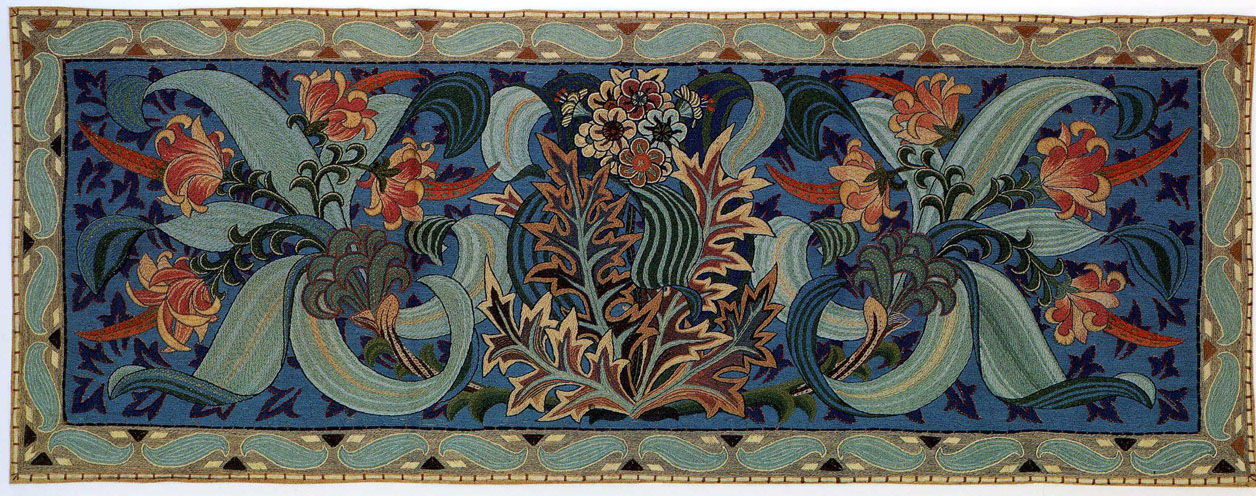
Embroidered Panel by George Washington Jack

 Illustration: George Washington Jack. Embroidered panel, 1890

George Washington Jack is the patriotically named Scottish American designer who spent much of his professional career in England. Jack trained as an architect and from 1882 became the chief assistant of Philip Webb, taking over sole responsibility for the company in 1900 when Webb retired.

Jack was largely responsible and best remembered for his prodigious amount of furniture design produced for, amongst others Morris & Co. Much of this work was produced during the 1880s when Jack became a convert to the English Arts & Crafts movement. This may well have been through his contact with William Morris, through Morris friendship with Webb and Jack's work for Morris & Co. However, Jack was no mere disciple of Morris, but in fact an independent and enthusiastic supporter of the movement which can be noted by his membership of such prestigious groups and associations as the Art Workers Guild for example.

Although trained as an architect and mostly remembered now for his furniture design work, Jack was also a designer of at least a certain amount of stained glass and textiles. As far as textiles are concerned, a particularly fine example is that of an embroidered panel produced in 1890. The example shown in this article is an excellent representation of what can be achieved through the medium of embroidery. Both the colours and composition are forceful, without appearing strident. There is a rich, though graphic quality to the work that places it very much as an example of the contemporary state of the decorative arts in England as it approached the final decade of the nineteenth century.

It is an example also of Arts & Crafts sensibilities, with the usual use of the abundant elements of the natural world. However, while much of the output of the English Arts & Crafts world was largely tempered by conservative values, along with the characteristic natural inclination towards understatement, Jack's embroidered panel is anything but. A certain element of the exuberant curving of the foliage could be seen as an indication of the inroads being made by the European Art Nouveau movement, and it must be remembered that this piece does date from 1890. However, although elements pertaining to Art Nouveau could be seen in the composition of this piece, it does not necessarily mean that that is what they are.

Art Nouveau struggled to make any headway in England, 1890 being still relatively early for an all out assault by a designer on the English market. This does mean that there was no evidence of the new European movement in England at the time, but is unlikely that a man as steeped in the philosophy of Morris, Webb and the Arts & Crafts movement would have seen the potential of Art Nouveau, when most saw it as a mere fashion fad that had no depth or substance. Most English and in fact British critics saw Art Nouveau as a European, but mostly French folly that would be replaced rapidly by an equally trivial folly. That Art Nouveau made such a fundamental and fairly universal impact on the decorative arts of not only Europe but also that of North America, and was to lead directly into the even more universal and all-pervading Art Deco style, perhaps showed the lack of objective judgement made by the British in regards to that of Europe, but more particularly France.

It would be tempting to imagine that Jack had brought an element of exuberant and youthful vitality from the new world to that of a stuffy and overly traditional old one. It seems unlikely that this is the case as Jack himself was very much an integral part of the English Arts & Crafts movement and of its traditional English philosophy, though it can perhaps not be ruled out entirely.

In the case of Jack's embroidered panel of 1890, it seems more a matter of exuberant detailing on the theme of the English Arts & Crafts mould, but perhaps more specifically of that of Morris. Notably, some of the central foliage seems reminiscent of a Morris design style, particularly some of his more Indian inspired textile work. The embroidered panel also seems similar in some respects to that of a furniture inlay. This perhaps should not be so surprising considering Jacks history of both furniture design and his woodcarving ability. However, whatever the reasoning or origins of the design piece, it is still a fine example of English embroidery work of the late nineteenth century, and should be taken as such.

Reference links:
The Arts and Crafts Movement
Arts and Crafts Movement (World of Art)
The Arts and Crafts Movement in Europe and America: Design for the Modern World 1880-1920
Textiles of the Arts and Crafts Movement
The Arts & Crafts Companion
Arts & Crafts Design

Mariska Karasz Embroidery

Illustration: Mariska Karasz Calla Lily embroidery 1951

The Hungarian American designer and artist Mariska Karasz approached the craft of embroidery with the sensibilities of a fine artist. Karasz is perhaps one of the earliest examples of an increasingly expanding genre within the general textiles framework, one which today we is familiarly known as textile or fibre art.

Karasz herself spent much of her career as a clothing designer. However, after the Second World War she reinvented herself and put her energies into the development of a highly successful second career in textile art. She used as the basis of this art, her Hungarian background and heritage of textile crafts, particularly that of embroidery. It was this craft that fuelled her imaginative compositions that took her all the way through the second half of the 1940s, but particularly through the following 1950s. This was a decade that saw an ever widening and large scale expansion within the craft world in general, with craft workers taking on many of the aspects of a fine art sensibility. There were a number of particularly fruitful and creative crossovers including a number of individuals from the fine art world who found themsleves working in ceramics, glass and textiles, sometimes for the first time.

Illustration: Mariska Karasz Babble embroidery 1955

The work that Karasz produced during the 1950s is an interesting blend of vocabulary from both design and art worlds. The artist plays with backgrounds and foregrounds, colour, tone and texture in order to produce a layered, abstract compositional framework that seems perfectly suited to the medium of embroidery. While the work is definitely set in its era with compositions producing abstract and colour textures that were so much a part of the 1950s, the work of Karasz is also timeless in its abstractness. The work of the artist was an exploration of a medium rather than an end result. However, more specifically it was that of a journey of discovery of a craft discipline, one that up until that point had, with some exceptions, seen little contemporary examination of its purpose, and more particularly its potential for the inventive and creative expansion of its parameters.

Illustration: Mariska Karasz Honeycomb collage 1959

It is individuals such as Karasz that have become the universal access points of all future creative explorers. To highlight and remember the work of artists and craftspeople such as these is to encourage all future exploration within and across disciplines and to constantly question boundaries, conventions and suppositions as to the role of such potentially diverse and adaptable disciplines as embroidery. Contemporary craft is fast reaching a point in its development whereby it is beginning to take on the maturity of a discipline that can explore its own reasoning. It is not an exaggeration to say that it has been a hard and long journey, but individuals such as Karasz have given both inspiration and much needed understanding within and without the craft world.

Illustration: Mariska Karasz Star Clouds collage 1959

Karasz work was extremely popular during the 1950s as indeed was she as an individual celebrity. She toured, lectured and wrote throughout the decade and is still remembered today as a pioneer of the fine art sensibility grafted onto the craft tradition. In the Reference links section below is a link to a very good and comprehensive website dedicated to the life and work of Mariska Karasz. Also listed below are a number of the books produced by Karasz still available on Amazon. You might also be interested to know that an exhibition presently being held at the Baltimore Museum of Art, Textiles Recycled/Reimagined running from March 10 to September 5 2010, has some examples of Karasz work within the exhibition.

Illustration: Mariska Karasz Hieroglyphics embroidery 1960


Reference links:
Mariska Karasz website
Modern Threads: Fashion and Art by Mariska Karasz
Adventures in stitches;: And more adventures-fewer stitches
The Good Housekeeping See and Sew: A Picture Book of Sewing
How to make growing clothes for your baby
Design and sew,
Growing Clothes
See and sew,: A picture book of sewing

Tambour Embroidery Work

Illustration: Nineteenth century tambour work

Tambour style embroidery work is said to have originated in China and then travelled throughout Asia via India, Persia and Turkey, eventually reaching Europe in the eighteenth century. Alternatively, it has been suggested that the style was brought directly to Europe from China by the French, also in the eighteenth century. Whichever is true, tambour work did not become widely popular until the middle of the latter half of the eighteenth century.

One of the main characteristics of the production of tambour or tambouring as it was often called was the use of two circular frames, one fitting snugly into another. This was in order to hold the backing fabric taught in order to produce the embroidered stitch work without the fabric losing its taughtness. The word tambour derives from the French word for drum which the outline of the hooped frame resembled.

Much of the earlier tambour work was produced using white stitching on a white background. This minimal but effective and accomplished embroidery technique proved to be extremely popular during the last half of the eighteenth and first half of the nineteenth century. 

Although it was an accomplishment of many women of the upper classes in Europe, much of the real work was produced by lower class women. Tambour work was produced on a variety of finely woven backing fabrics, muslin being a particular favourite. 

Nineteenth century versions of the discipline tended towards a more colourful spectrum. A wide range of coloured silks and gold thread became popular, allowing the discipline to expand and diversify from the original whitework. By today's standard many might well see the original whitework as being of a superior nature to that of the later coloured work. However, it must be remembered that many of these traditional handcrafts, and particularly those concerning textiles, were struggling to survive in the nineteenth century. The marketplace had reached a particularly competitive and robust phase with industry putting intense pressure on the scope and availability of hand crafts. 

The nineteenth century saw a range of innovations and transformations, many of which were speedily introduced into the domestic and interiors market. A wide colour range was an integral part of the nineteenth century's decorative palette and therefore tambour work, along with many other versions of textile craft, could only helplessly reflect those trends and impositions.

True tambour work used a hook with a wooden handle, as opposed to the more usual needle as can be found used in many other forms of embroidery craft. This has led many to see a link, or at least certain similarities, between tambour work and crochet some even believing that crochet directly derived from the earlier tambour work. Although having certain similarities, a tambour hook is much finer and sharper that the average crochet hook.

Tambour work has been used highly successfully and effectively within the fashion world, very much since its original popularity in the eighteenth century. It is still used, to a certain extent, within the confines of the haute couture world. However, it is also still popular with a number of individuals, both amateur and professional. It is a relatively cheap craft to launch into, and seems likely to remain in use in a variety of guises for at least the foreseeable future.

Reference links:
The dictionary of needlework;: An encyclopaedia of artistic, plain, and fancy needlework
Mary Thomas's Dictionary of Embroidery Stitches
Clover Kantan Couture Bead Embroidery Tool-
Clover Turnable Hoop-7-1/2"
Tambour Beading With a Ring Frame
Embroidery Stitches - 1912 Reprint
Complete Book of Embroidery: Includes Crewelwork, Goldwork, Ribbon Embroidery, and Embellishments

Bosnian Embroidery

Illustration: Traditional embroidery for a man's shirt

The history of Bosnia is one that represents a complex patchwork of cultures and religions. The decorative crafts, particularly those concerned with textiles, reflect that same diversity.  Embroidery has always been an important component of cultural identity, no more so than in the Balkans where shifting political boundaries have for centuries been largely irrelevant compared to those of the cultural variety. Bosnia may have sat uncomfortably within the sphere of empires and dominating cultural regions. However, it has managed to produce decorative work, which although influenced by those around it, does reflect the diversity within its borders.

Illustration: Traditional Bosnian Islamic costume

Embroidery in Bosnia can be crudely segregated into three distinctive styles. Urban centres were largely Turkish administrative points for the Turkish Empire and so were therefore mostly Islamic in makeup. The south and west of Bosnia had a stronger decorative affiliation and strong trade links with the Mediterranean and Italy in particular. The northern part of the region bordering the Austro Hungarian Empire was much more heavily influenced by the styles of Central Europe. Obviously these are generalizations and the complexities of Bosnian regional and specifically those of a highly localised variation, abounded.

Illustration: Traditional Bosnian Christian costume

As with many regions embroidery was often a domestic craft produced by women. Both Islamic and Christian families used embroidery extensively for festivals and particularly weddings. However, embroidery had a much wider scope than this and could be found as a decorative effect used domestically and as an addition to other textile crafts such as knit. Knitted socks with embroidered embellishment was a particular feature of the region, though not necessarily Bosnia specifically.

Although there are regional differences in pattern work throughout Bosnia and particularly within national costume, floral based decorative work was popular in both urban and rural areas. It can sometimes be confusing in trying to differentiate between the main decorative style in Bosnia, as for example both Islamic and Christian groups used floral motifs extensively, as did the two other main influences on the region Italy and Austria.

Illustration: Traditional Bosnian embroidered cap

Part of the problem with identifying the decorative origins of work produced in such diverse cultural areas as can be found in Eastern Europe and the Balkans, is that of the multi-layered effect of history and its influence. There are so many cultural layers of peoples, empires and religions that have influenced and guided the decorative effects of at least a certain proportion of embroidery work within the region, that it will always be difficult to disentangle those influences on the pattern work of the region. However, this does not mean that much of the embroidery work within Bosnia cannot be identified with a specific religion or ethnic background.

Recently due to the violent fragmentation of Yugoslavia, Bosnia has had to restructure itself along largely religious, rather than truly ethnic grounds. Catholic Bosnians have become associated with Croats in the west. Greek Orthodox Bosnians have become associated with Serbians in the east and north, while the largely urban Islamic Bosnians occupy the centre of the country.

Illustration: Traditional Bosnian embroidered cap

Because of this largely artificial division that did not really exist within the old Yugoslavia, Bosnians have had to redistribute themselves, often forcibly, to the regions that their religion identifies them with. This has largely broken up the traditional patchwork of cultural and craft traditions of the region, scattering those traditions across the country and beyond. However, those same traditions have managed to survive and in time may well flourish. New traditions are forming from the old as craftspeople from different backgrounds interact in the new divisions of Bosnia. This interaction will hopefully lead to new pathways for craft work in general and Bosnian embroidery specifically.

Reference links:
Peasant Art in Austria and Hungary
Embroidered Textiles: A World Guide to Traditional Patterns